
What makes a trench drain suited for residential vs. commercial projects?
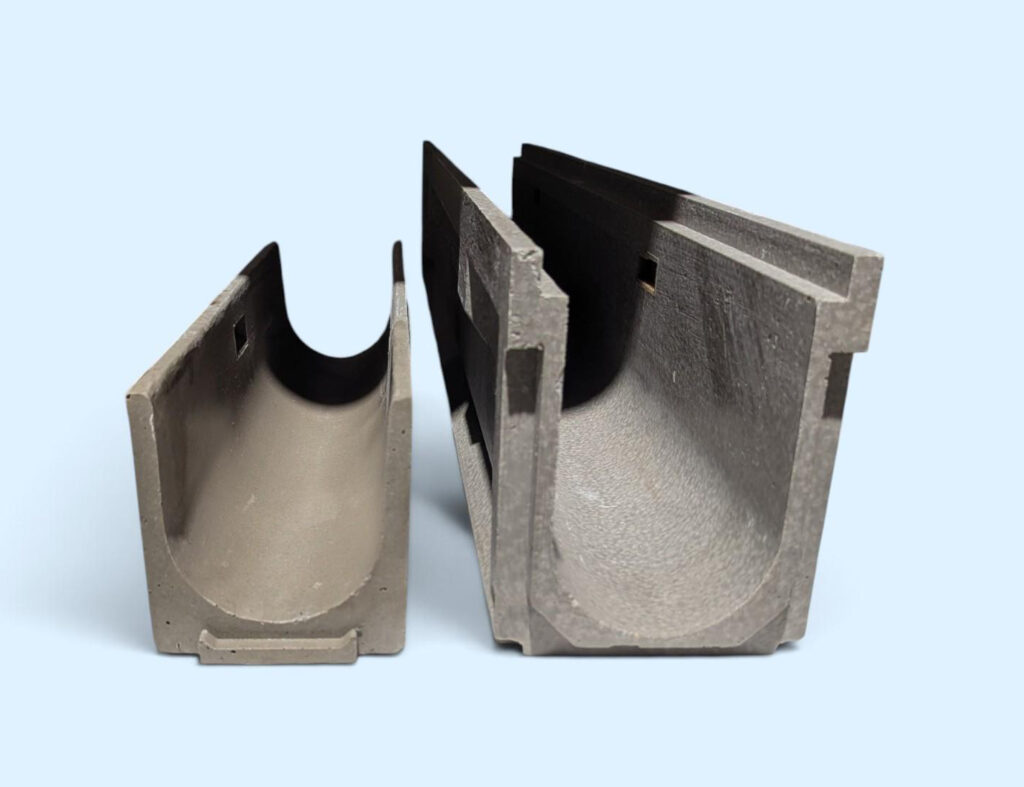
Manufacturers make both residential drains and commercial-grade trench drains. There are a number of trench drain manufacturers that sell 4 inch wide (100 mm) polymer concrete channels, but we’re comparing two POLYCAST® trench drains by Hubbell. Several differences between the smaller 400 Series and the 600 Series set them apart as residential or commercial polymer concrete channels.
Similarities in POLYCAST® Drains
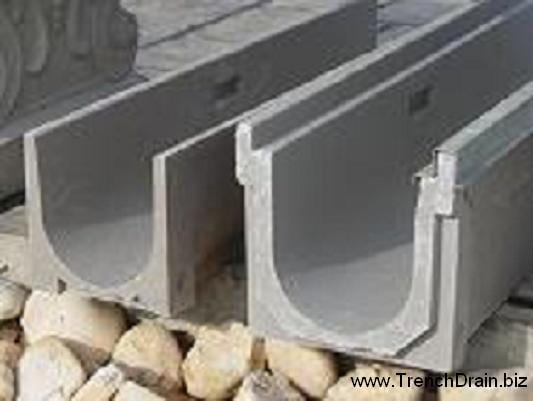
Both the 400 Series and 600 Series drains are made from the same polymer concrete composition, which is a mixture of silica sand and epoxy resin. This material, while taking on some of the polymeric properties of the resin, displays the compression strength of concrete due to the high amount of silica sand. And though the material has enough strength to withstand heavy traffic while in service, it behaves as a ceramic and will crack upon impact if dropped prior to installation.
Both channels have a similar 4” interior width and are available in 2 foot and 4 foot lengths. From a functionality point of view, in low flow, low load applications both products perform equally. Most residential driveway applications would fall into this category.
Differences from Residential to Commercial
Here is where the differences start to set the two trench drains apart.
Channel Design
The 600 Series has thicker walls than the 400 Series, which allows for heavier load bearing capabilities. Also, the channel end of the 600 series has a more integral male-female connection than does the 400 series product. Additionally, the grate used on the 400 series rests on top of the channel, while the 600 series channel has a recess within the channel for the grate to lie. The difference being that the placement for grates in the 600 series are more secure and less likely to shift in place. Another advantage is that the grates take less of the vehicle traffic load as it’s dispersed into the sides of the channel.
Flow Rates
A major difference between the two products is that the 400 channels are all non-sloped while the 600 series channels are predominantly pre-sloped. The pre-sloped character of the 600 channel ensures that water flows more quickly, thus allowing for higher overall flow rates. 600 Series channels can still be purchased without slope and are needed when designing complex drainage systems. The POLYCAST® 600 has options for neutral channels that will act similarly to the 400 system but with more advantages. The system has become diverse in its offerings so that runs can be neutral, sloped or even cascading when applicable.There are now six different neutral channels available which can provide a variety of depths. These channels include: 600N at 4.06″, 605N at 5.63″, 610N – 7.19″, 615N – 8.75″, 620N – 10.31″ and 625N – 11.88″.
Grating Choices
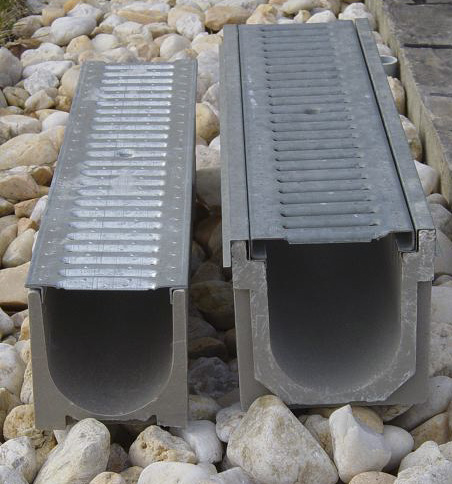 The 400 Series product comes with a Class A galvanized steel slotted grate that is capable of withstanding loads from small automobiles. This is the only grating option.
With the 600 series, you get a wider selection of grating options. You can get a Class B galvanized steel slotted grate or upgrade to an iron grate for heavier loads. When environments have harsh conditions and or corrosive effluents, 316L stainless steel grate option are also available.
In fact, there are over 20 different grates options and two frame options for the 600 Series channels.
600 Series Reinforcements
The frames available with the 600 Series include a galvanized steel channel protector (shown above). This is a steel edge covering that keeps the channel from deteriorating while in use. The channel protector is also available in stainless steel. For heavy load capabilities (fork truck or airline) a cast iron or high density polyethylene (HDPE) frame is used to cover the channel prior to inserting a ductile iron grate.
Pricing
A final comparison between these two products is price. The 400 series product is manufactured for economy. It is a light duty product that is easily manufactured due to its simple design. It has no complicated angles and only one grate option. Because of this, it sells for approximately 30% less than the comparable 600 series product.
With the 600 series, you get flexibility and value. Though more expensive than the 400 series, the 600 series allow for higher load capabilities which can be further improved by changing your frame or grate. The 600 channels are more expensive due to the sturdier and pre-sloped design. And, of course, your choice of grating will directly influence your final $/foot price, especially if your application requires a stainless steel grate.
